
01
Understanding A3R
02
Philosophical Foundations
03
Human Development
04
Practice & Application
05
Future & Contribution
Ubuntu · Sankofa · Ma’at · Nommo
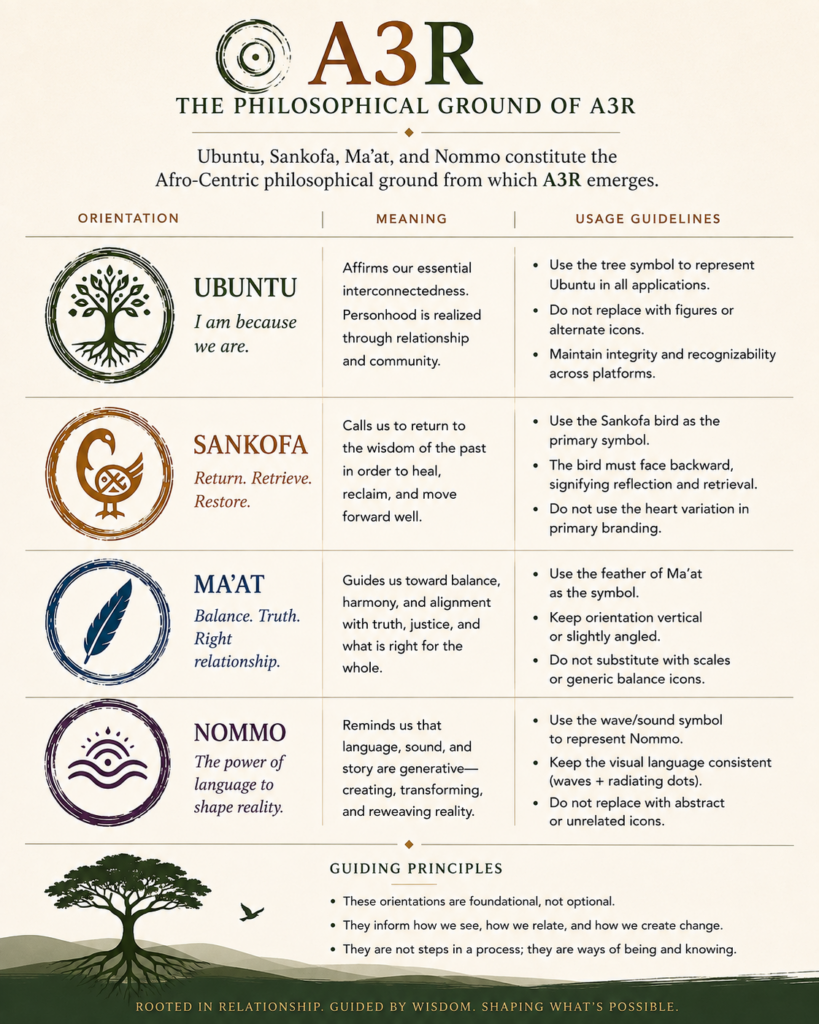
These four traditions constitute the Afro-Centric philosophical ground from which A3R emerges.
They are not cultural additions to a framework developed somewhere else. They participate in how A3R understands human being, becoming, relationship, return, ethical participation, language, meaning, and flourishing.
Relational Being
Ubuntu turns us toward the recognition that our humanity is relationally constituted and relationally lived.
Return and Becoming
Sankofa reminds us that return is not the opposite of becoming. Return can participate in becoming.
Right Relationship and Ethical Participation
Ma’at asks about the quality and consequences of our participation and whether the conditions we help create contribute toward greater truth, justice, balance, reciprocity, and flourishing.
Language and Generative Meaning
Nommo reminds us that words do more than describe reality. Language, naming, expression, and meaning-making participate in what becomes possible.
Ubuntu is rooted particularly in the Bantu-speaking cultures of Southern Africa; Sankofa comes from the Akan people of Ghana and Côte d’Ivoire; Ma’at originates in ancient Kemet (Egypt) in northeastern Africa; and Nommo is associated especially with the Dogon people of Mali in West Africa.
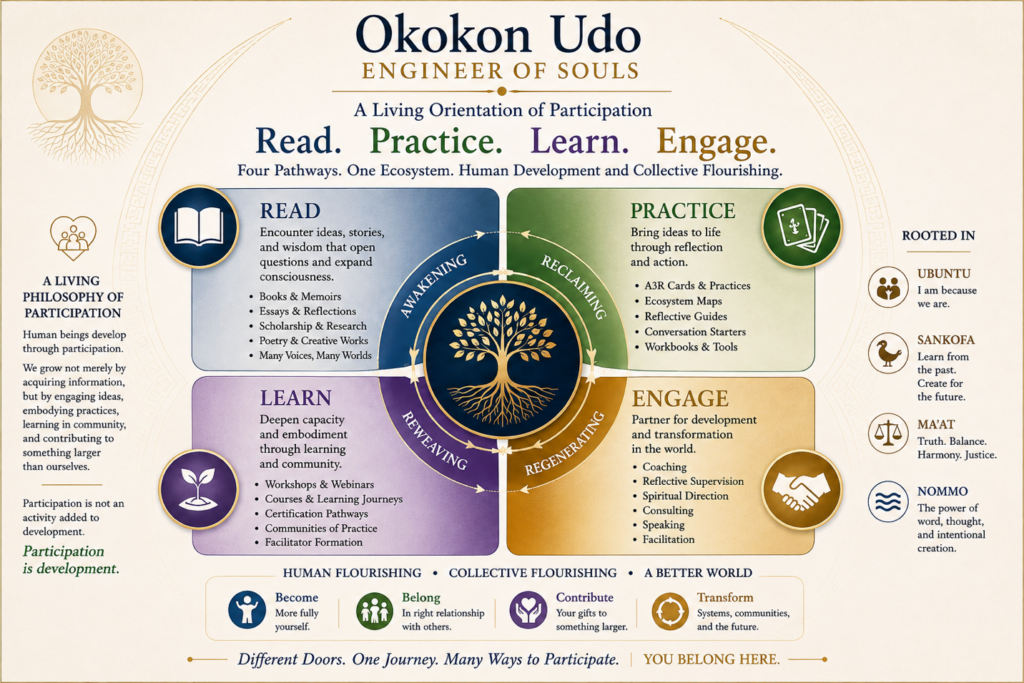
A3R is an Afro-Centric framework for leadership, coaching, human development, and systems transformation.
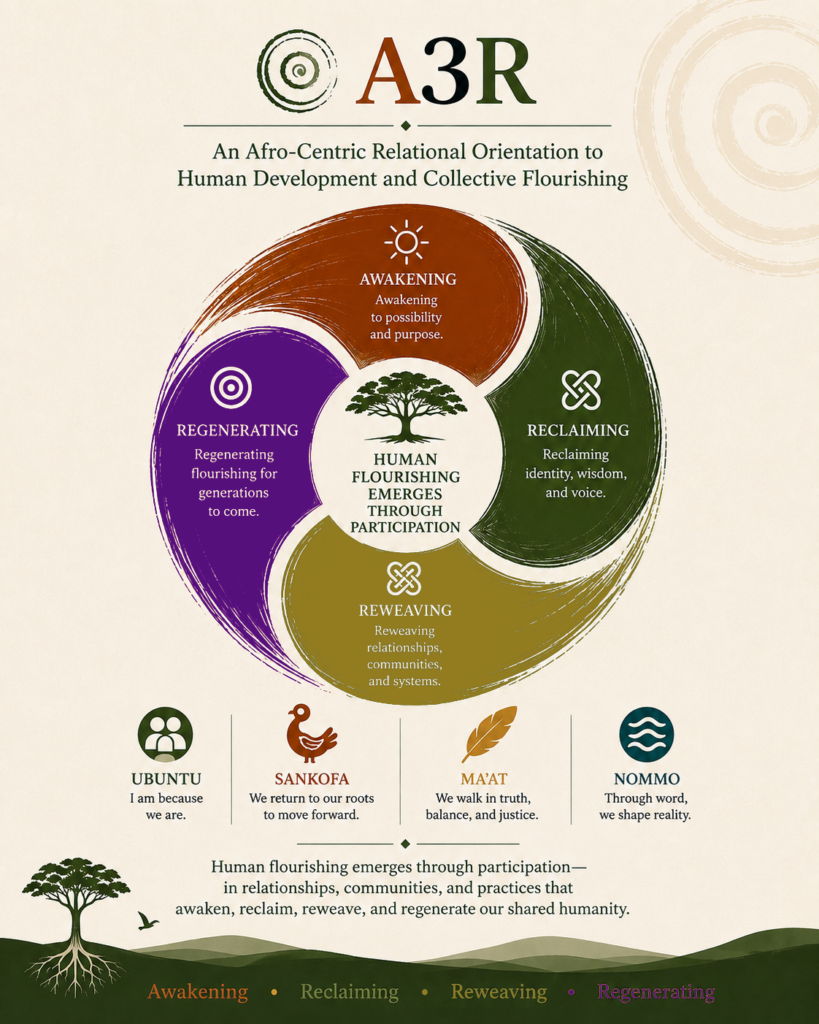
Organized around four developmental movements—Awakening, Reclaiming, Reweaving, and Regenerating—A3R offers a relational approach to understanding how individuals, communities, and systems evolve over time.
Rather than focusing exclusively on performance, A3R invites deeper attention to identity, relationship, meaning, participation, contribution, and collective flourishing.
A3R represents four interconnected movements:
Becoming aware of self, others, and the conditions shaping experience.
Recovering identity, wisdom, agency, voice, and possibility.
Cultivating healthier relationships, communities, and patterns of participation.
Contributing to conditions that support life, growth, and flourishing for present and future generations.
These movements are not linear stages but recurring invitations throughout life.
A3R was developed by Dr. Okokon O. Udo, an executive coach, coach educator, organization development practitioner, and scholar-practitioner.
Drawing from decades of work across healthcare, leadership development, coaching, community engagement, and higher education, Dr. Udo created A3R as a framework for understanding and supporting human becoming.
His work reflects a longstanding commitment to what he often describes as the work of soul engineering: creating conditions that support human becoming and collective flourishing.
A3R represents both an intellectual contribution and a lifelong inquiry into what helps individuals, communities, and systems flourish.
May we remember that we did not arrive here alone.
May the wisdom carried through land, story, spirit, memory, and relationship
find us willing to listen.
May we enter this ground with humility—
not to possess it,
but to be changed through our encounter with it.
A3R gives expression to becoming through four recurring movements:
Seeing more fully what is present.
Awakening invites attention—to what is visible, what has been overlooked, and what may now be asking to be seen.
Returning to what has been forgotten, fragmented, silenced, minimized, or set aside.
Reclaiming recognizes that sometimes becoming requires return.
Relating differently and participating in the emergence of new patterns of relationship, meaning, and possibility.
Reweaving attends to what happens when awareness and return begin to change how we participate.
Participating in ways that renew, sustain, restore, and contribute to flourishing.
Regenerating asks what our participation might help make more life-giving and possible.
A3R begins from a relational understanding of being:
Human being and becoming are constituted through relationship.
We are distinct without being separate.
We possess agency without possessing complete control.
We influence what becomes while also being shaped by relationships and realities beyond ourselves.
Community is not merely context.
Ancestry is not merely history.
Place and nature are not simply environment.
Spirituality and the unseen are not optional additions to an otherwise complete account of human life.
They participate within the living relational field through which human being and becoming unfold.
From this center of gravity, development asks more than:
What will I become?
It also asks:
How will I participate in what is becoming?
A3R is Afro-Centric because it begins from an African-centered philosophical ground for understanding human being, becoming, relationship, and flourishing.
It does not begin with an existing developmental framework and then add African concepts to make that framework more culturally inclusive.
A3R begins elsewhere.
Ubuntu, Sankofa, Ma’at, and Nommo constitute the philosophical ground from which the orientation emerges.
Its Afro-Centric grounding is therefore not primarily about whom A3R is for.
It is about where A3R begins.
No.
A3R is Afro-Centric in its grounding and universal in its invitation.
People do not need to be African, of African descent, or Indigenous to encounter, study, practice, question, or participate in A3R.
Nor does A3R claim to represent Indigenous traditions generally. Indigenous peoples and knowledge traditions are diverse, culturally located, and deserving of engagement on their own terms.
A3R speaks from a particular ground while extending an open invitation.
Those entering from other traditions are invited to encounter the orientation with curiosity, humility, respect, and awareness of their own location.
Universal invitation does not mean universal claim.
No.
A3R is nonlinear, recursive, relational, contextual, and ongoing.
Awakening, Reclaiming, Reweaving, and Regenerating are not stages through which everyone progresses in the same order.
Different movements may be present simultaneously. One may lead us back to another. What appears to be return may actually represent deepening.
There is no universal timetable, prescribed pace, or developmental hierarchy in which later automatically means better.
A3R can be encountered through all three, but none alone adequately describes it.
It is best understood as a living orientation.
It has a framework that makes aspects of the orientation visible and communicable.
It has Four Movements that give language to recurring movements of becoming.
It includes practices and tools through which the orientation can be engaged and embodied.
It generates scholarship through which its philosophical claims and implications can be explored, questioned, and placed in conversation with other knowledge traditions.
And it can influence ways of living and relating because an orientation ultimately matters through how we participate.
It is an orientation to inhabit, a framework to explore, a practice to embody, and an ecosystem in which to participate.
No.
And unfinished does not mean undefined.
A3R has a recognizable philosophical ground, a relational understanding of human being and becoming, Four Movements, a developing body of scholarship and practice, and an ecosystem through which people can participate.
These give A3R coherence.
But coherence does not require closure.
Calling A3R a living orientation means remaining open to what sustained inquiry, scholarship, practice, relationship, critique, experience, and participation may reveal.
We speak clearly from what we know now while remaining open to what relationship may yet reveal.
A Guided Introduction to the Living Orientation of A3R
Thirty-one questions explore the philosophical ground of A3R; human being and becoming; participation; practice and formation; scholarship; the A3R ecosystem; and collective human flourishing.
There is no single place to begin.
They are doorways, not stages. Trust the doorway that brought you here.